There seems to be nothing in your cart.
Didn't find what you were looking for? Contact our consultant.
To save your shopping cart until your next visit, create an account or register .
Browse our Hits sales


There seems to be nothing in your cart.
Didn't find what you were looking for? Contact our consultant.
To save your shopping cart until your next visit, create an account or register .
Browse our Hits sales




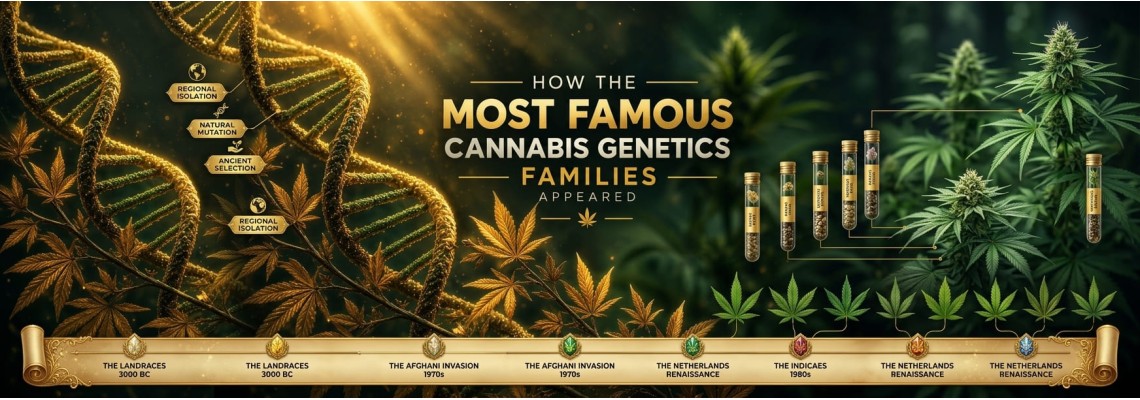
In this article we will tell how the most famous cannabis genetics families were formed — from historical regional lines to modern hybrids. You will learn where Haze, Kush, Skunk, Afghani, Northern Lights and White came from, how they influenced the development of breeding and why their genetic heritage is still found in modern strains.
The modern cannabis seed catalogue may seem endless: thousands of names, dozens of breeding brands and a huge number of new hybrids. However, behind this diversity lies a much more compact history. Many modern genetics have common ancestors or originate from several historically important breeding directions. Names such as Haze, Kush, Skunk, Afghan, Diesel, Cookies and others have long become recognisable far beyond individual breeding projects. Over time, entire genetics families formed around them that continue to influence the creation of new hybrids.
At the same time, a “genetics family” is rather a convenient description of related or historically connected lines than a strict scientific classification. Modern cannabis genetics is significantly more complex than popular categories like “sativa” and “indica”: over decades of breeding, numerous crosses, transfers of genetic material and selection of plants for different traits have taken place. Therefore the history of the well-known families is not the history of individual strains that once appeared and remained unchanged. It is the history of genetic directions that developed, intersected and became the basis for new generations of hybrids.
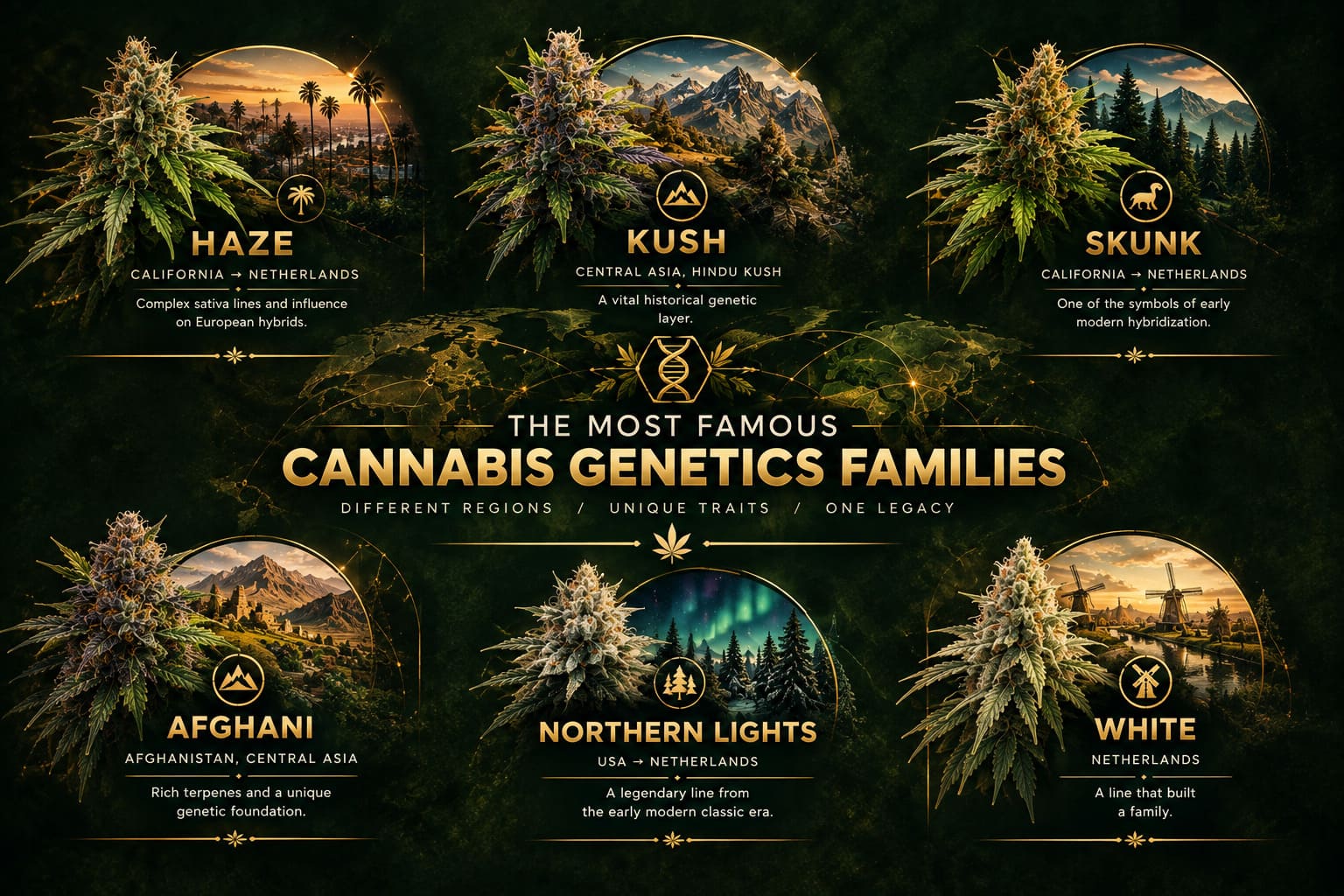
A genetics family can be conditionally understood as a group of lines and hybrids connected by common origin or by the noticeable influence of one historical line.
The process can be imagined quite simply:
original line → first hybrid → selection → new line → new crosses → an entire family of hybrids
That is why a modern strain rarely exists completely isolated from the rest of the genetics.
Before the emergence of the modern seed industry, different Cannabis populations formed in different regions. Climate, day length, altitude and human selection gradually created differences between them. Later breeders began combining genetic material from different regions. Thus regional populations became the starting material for creating hybrids, and some of the resulting lines turned out to be so successful that they themselves became parents for subsequent generations.
Today this heritage can be seen across virtually the entire spectrum of modern breeding — from classic
photoperiod feminized strains to autoflowering hybrids. At the same time, characteristics such as
high THC, flavour, plant structure or flowering time are already the result of many years of selection and the combination of various hereditary traits.
Key families
| Family | Main historical connection | Significance for breeding |
| Haze | California, then the Netherlands | Complex sativa lines and influence on European hybrids |
| Kush | Central Asia, Hindu Kush | Important historical genetic layer |
| Skunk | California, then the Netherlands | One of the symbols of early modern hybridisation |
| Afghani | Afghanistan and Central Asia | Source of Central Asian genetic material |
| Northern Lights | USA → Netherlands | Iconic line of early Dutch breeding |
| White | Netherlands | Example of an individual line turning into an entire family |
Some of the first particularly influential directions were Haze, Kush and Skunk. But each of them has a completely different history, and some versions of their origin are still a matter of debate.
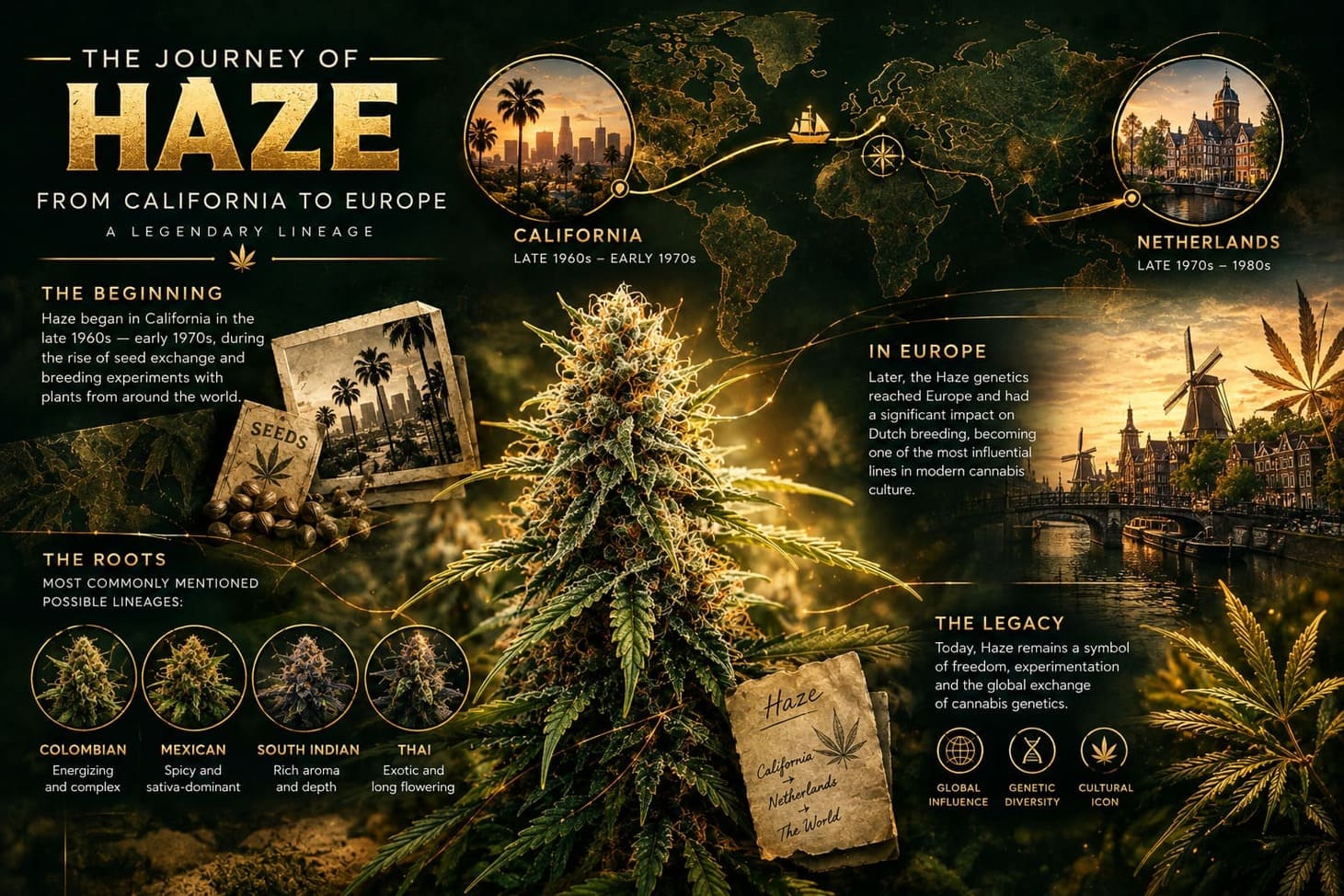
The history of Haze began in California in the late 1960s – early 1970s. It was then that the culture of seed exchange and breeding experiments with plants from different regions of the world was taking shape. Later the genetics associated with Original Haze reached Europe and had a noticeable influence on Dutch breeding.
The exact pedigree of Original Haze has not been fully confirmed. The most widespread version links early Haze with several tropical lines, among which Colombian, Mexican, South Indian and Thai genetics are named. However, this scheme is largely based on later accounts by breeders and participants of that period rather than on preserved documents about every cross. Therefore it is more correct to regard it as a historical version rather than an established genetic fact. The name Haze Brothers itself is also surrounded by legends. In popular sources it is linked to two brothers from the Santa Cruz area, yet later testimonies indicate that the story may have been more complex. A significant part of the information about the first generations of Haze was transmitted orally.
In the late 1970s – early 1980s Haze reached the Netherlands, where a new culture of breeding and preservation of seed material was actively developing. European breeders began using Haze in new combinations with already known lines. It was this stage that turned a relatively local Californian direction into a broad genetic family. Historically associated with Haze are such well-known names as Neville’s Haze, Super Silver Haze and Jack Herer, as well as various hybrids involving Northern Lights. At the same time the origin of specific modern strains may differ, so each pedigree must be examined separately.
The main significance of Haze lies not in one particular strain but in its role as a source of genetic material for subsequent generations of hybrids. After spreading in the Netherlands, breeders gained the opportunity to combine it with other lines and then use the resulting hybrids in new crosses. Thus one historical line gradually turns into an entire family.
Conditionally the path of Haze can be represented as follows:
Californian breeding → spread in Europe → preservation of lines → new crosses → numerous Haze hybrids
Therefore the modern word Haze does not always denote one strictly defined genetics. Behind it may lie a whole series of lines with different parents and breeding history. This is an important principle for the entire article: the family name does not guarantee the genetic identity of all strains that use it.
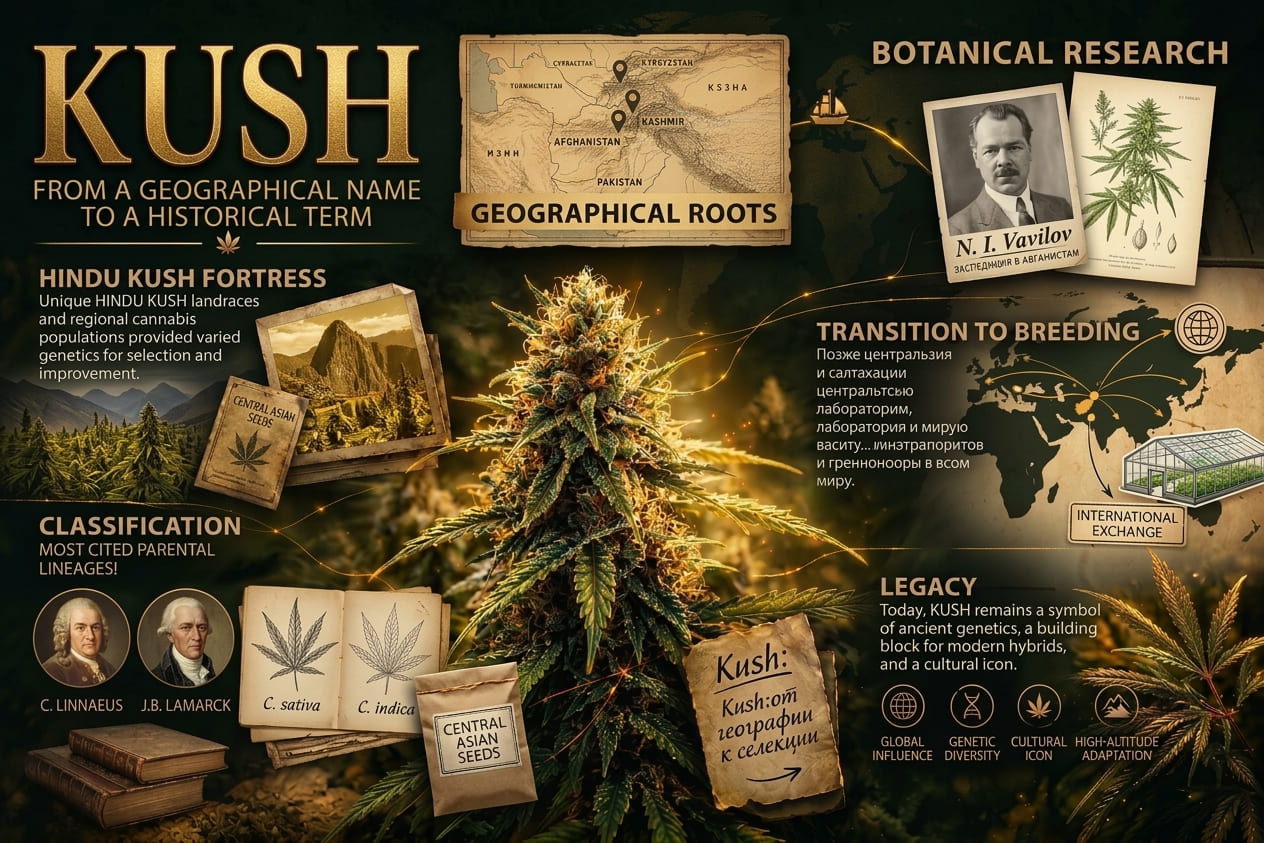
Unlike Haze, the history of Kush begins much earlier and is primarily connected with the geography of Central Asia. The word Kush itself originally did not denote a specific genetic line. It is linked to the Hindu Kush mountain system located on the territory of modern Afghanistan and Pakistan. This region was an important part of the historical range of various Cannabis populations.
In Central Asia there existed many local populations adapted to different conditions — from mountain valleys to arid plains. Therefore it is incorrect to regard the region as the place of existence of one homogeneous “genetics”. Expressions such as “Afghan genetics” and “Kush” in a historical context rather describe the geographical origin of certain populations than one specific variety.
The history of Kush is closely intertwined with the botanical classification of Cannabis. In the 18th century Carl Linnaeus described the plant as Cannabis sativa. Later Jean-Baptiste Lamarck proposed the name Cannabis indica for plants from India that differed from European specimens. In the 20th century plants of Central Asia, including those associated with Afghanistan and the Hindu Kush, were increasingly grouped with what was called “Indica”. However the modern opposition “Sativa versus Indica” significantly simplifies the real picture. Historical populations were more diverse, and subsequent hybridisation further blurred the original boundaries between the groups.
The modern conception of Central Asian Cannabis groups took shape relatively late. An important role was played by botanical research and expeditions of the 20th century, including the work of Nikolai Vavilov in Afghanistan in the 1920s.
This shows an important feature of the history of Kush: the very existence of plants in Central Asia is significantly older than the modern name and the scientific classification of the populations associated with them.
During the 20th century plants from Central and South Asia gradually became part of the international exchange of genetic material. Geographical names began to be used as designations of origin and then turned into recognisable breeding terms. Thus Kush travelled the path from a geographical name to an element of modern breeding culture. At the same time one cannot speak of a single ancient “Kush genetics”: different historical populations differed from one another, and many modern plants are already the result of numerous crosses. Therefore Kush is simultaneously a geographical, historical and cultural term, not a single botanical category.
It was the Central Asian populations that became one of the important sources of genetic diversity for 20th-century breeders. Their significance lies not in the transmission of one “pure line” but in the preservation and further use of an entire genetic layer.
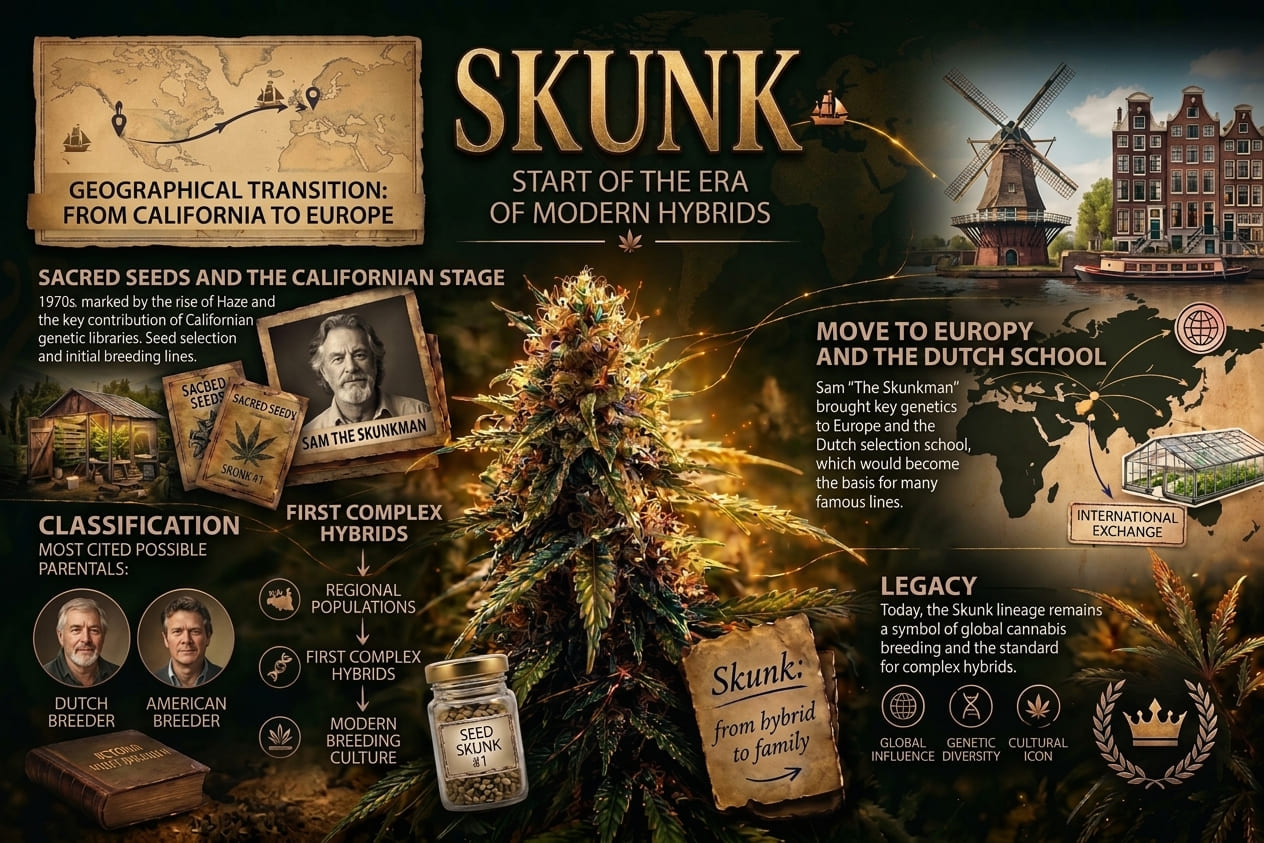
If Kush is primarily connected with geographical origin, then Skunk already represents a different era — the time of purposeful creation of complex hybrids. The history of Skunk is connected with California of the 1970s and the name of David Watson, better known as Sam the Skunkman. Later he became one of the key figures in the spread of American genetic material in Europe.
In the case of Skunk the talk was already about the purposeful combination of genetic material from different regions. The origin of Skunk #1 is usually linked to Afghan material and sativa lines from Central and South America. However the specific details of the early crosses are reconstructed mainly from the recollections of participants and later publications. It is here that the change in the approach to breeding is particularly clearly visible. Different geographical groups began to be regarded not only as independent populations but also as sources of certain hereditary traits that could be combined in new combinations.
In the 1970s an environment formed in California where such experiments began to take place regularly. One of the notable collectives was Sacred Seeds, associated with Sam the Skunkman and other American breeders. Instead of simply preserving a liked regional population, breeders created new combinations and then selected the most interesting lines from them.
For the history of Cannabis this was an important transition:
regional populations → first complex hybrids → modern breeding culture
In the 1980s American genetic lines began to move actively to Europe. Sam the Skunkman moved to the Netherlands, where a new environment for breeding and seed distribution was already forming. California gave European breeding a significant part of the starting material, and the Netherlands became the platform for its further development. Thus the history of Skunk turned out to be closely connected with the formation of the Dutch breeding school.
Over time Skunk ceased to denote only one historical line. The name began to be used for a large number of subsequent hybrids and breeding projects. This does not mean that they are all genetically identical. As in the case of Haze, there is a difference between the historical line and the modern family of names. The historical significance of Skunk therefore lies primarily in the fact that this line became a bridge between regional genetic material and modern systematic hybridisation.
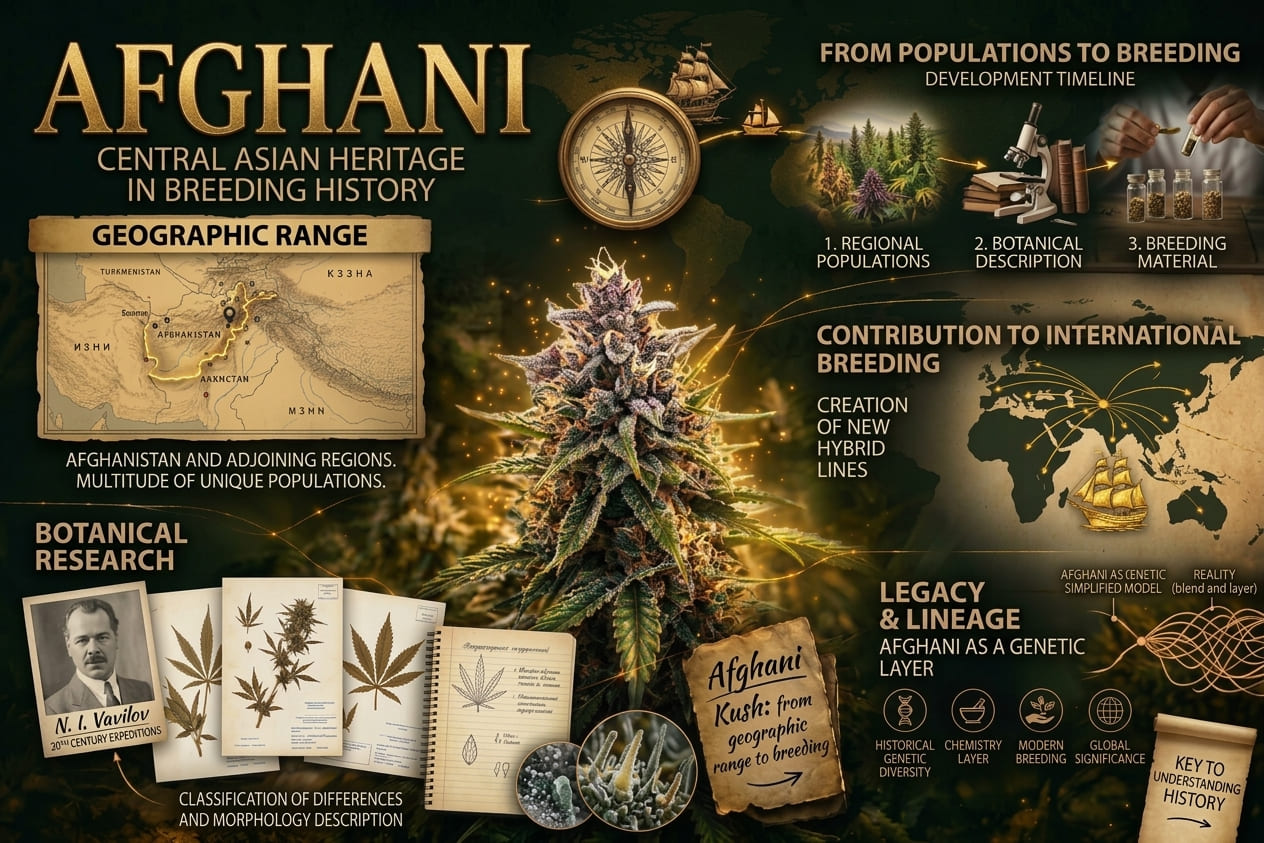
After Kush it is logical to turn to Afghani — a term connected with the populations of Afghanistan and neighbouring areas of Central Asia. Here too it is important not to perceive Afghani as one ancient and genetically homogeneous line. Historically it was a matter of many local populations that existed in different areas of Afghanistan, Pakistan and Central Asia.
Afghanistan is located at the intersection of the historical regions of Central and South Asia. Cannabis has been present here for a long period, yet the notion of one “Afghan genetics” formed significantly later.
Botanical expeditions and herbarium collections of the 19th–20th centuries allowed researchers to gradually describe the differences between regional populations. An important role was played by the research of Nikolai Vavilov and his colleagues.
In the scientific literature plants of Central Asia gradually began to be distinguished by a combination of morphological, chemical and genetic traits. Some modern classifications use for Central Asian domestic forms the designation Cannabis sativa subsp. indica var. afghanica. But here too it is a matter of the historical diversity of populations, not of one unified modern line.
A sequence characteristic of Cannabis emerges:
first there were regional populations → then botanists began to describe them → later modern breeding names appeared.
In the second half of the 20th century Central Asian genetic material was actively used in international breeding. Breeders combined plants from different regions, creating new hybrid populations. Therefore the significance of Afghani lies primarily in the contribution of an entire group of Central Asian populations to the subsequent genetic history of Cannabis.
Afghani is often automatically associated with Indica, yet historically these concepts were not synonyms. The names sativa and indica were used by botanists in different periods in different ways, and extensive hybridisation over time further blurred the boundaries between the categories. Therefore when studying the origin of a particular genetics it is more accurate to take into account geography, the history of the population and the pedigree rather than trying to determine its origin solely by the label “Sativa” or “Indica”.
The movement of plants between regions also led to the mixing of local populations with introduced material. Therefore a modern plant originating from a certain region is not necessarily an exact genetic continuation of the historical local population. This is one of the main reasons why the pedigrees of old genetics can often not be restored to a single original line. Afghani is more correctly perceived as a historical genetic layer that became an important part of modern breeding.
Northern Lights shows the next stage in the development of genetics — the transformation of starting material into an independent breeding line. Its early history is connected with the north-west of the USA, yet the exact origin of the first Northern Lights plants remains not fully determined.
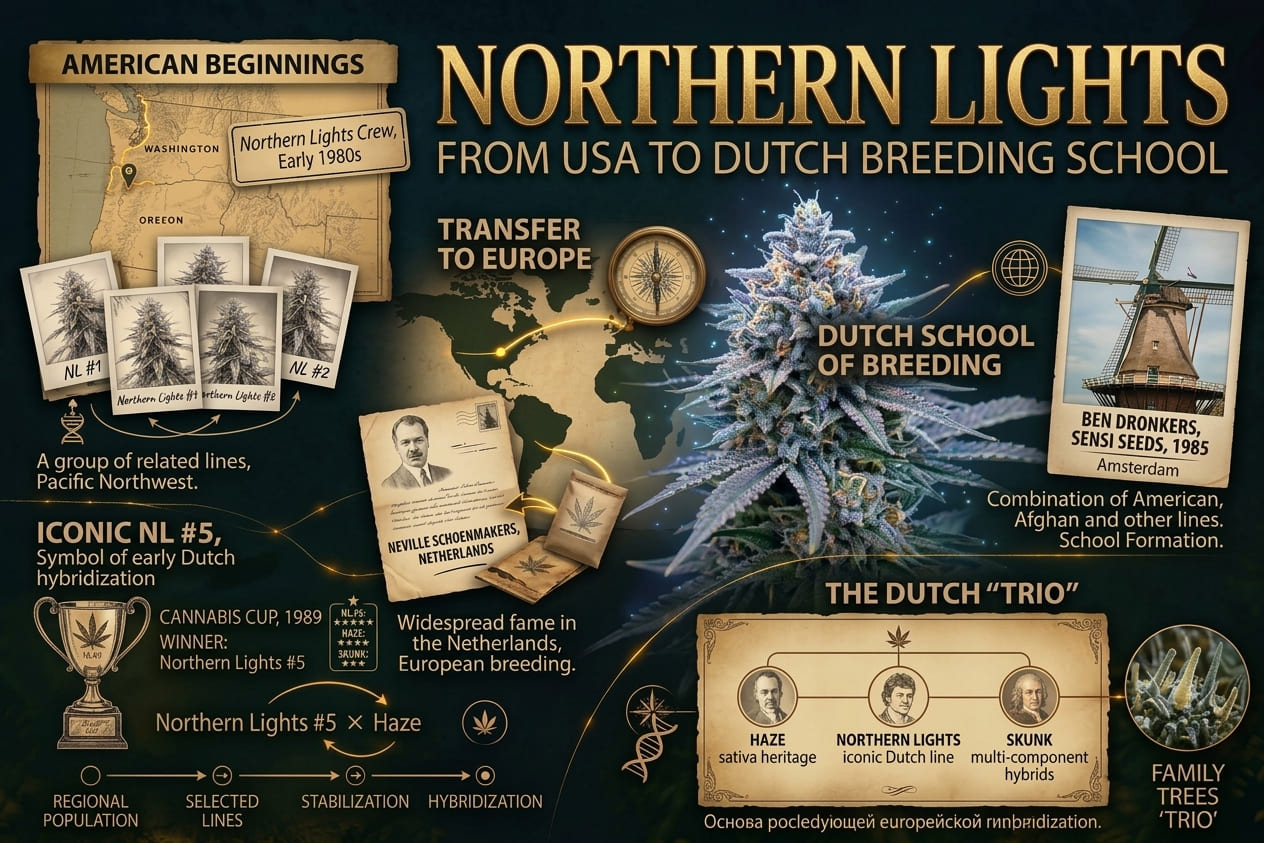
In the early 1980s a group of breeders known as the Northern Lights Crew worked with plants in the Pacific Northwest of the USA. There existed several variants of Northern Lights denoted by numbers. Northern Lights #1, #2, #5 and other variants did not necessarily represent successive generations of one plant — rather it was a matter of several original specimens and lines. Thus already at an early stage Northern Lights was rather a group of related lines than a single plant.
The most important turning point occurred after the transfer of seeds to Neville Schoenmakers — one of the key figures of the early Dutch breeding scene. In the Netherlands Northern Lights gained wide fame and became part of the forming European breeding culture, where American lines, Afghan material and other genetic groups were combined in new projects. Especially important was the year 1985. It was then that Ben Dronkers founded Sensi Seeds, and Northern Lights and Afghani became part of the developing Dutch breeding school.
Among the various variants of Northern Lights a special place was taken by Northern Lights #5. In the late 1980s it became one of the most noticeable lines of the European scene and received international recognition after winning the Cannabis Cup in 1989. Later the genetic material of Northern Lights was used in new breeding programmes. One of the best-known examples became Northern Lights #5 × Haze, which became a symbol of early Dutch hybridisation.
Here it is particularly clearly visible how the principle of forming genetics changed:
regional population → selection of individual lines → stabilisation → further hybridisation
The name already told not only about geography but also about the breeding history of the plant.
In the history of Dutch breeding Northern Lights is often considered together with Haze and Skunk.
| Line | What it represents in history |
| Haze | Complex American history and sativa heritage |
| Skunk | Early multi-component hybrids |
| Northern Lights | Iconic line that developed in the Netherlands |
Their combination became part of the foundation of subsequent European hybridisation. Northern Lights therefore occupies an intermediate position between old regional genetics and modern breeding, where one well-known line can become a parent for dozens of new hybrids.
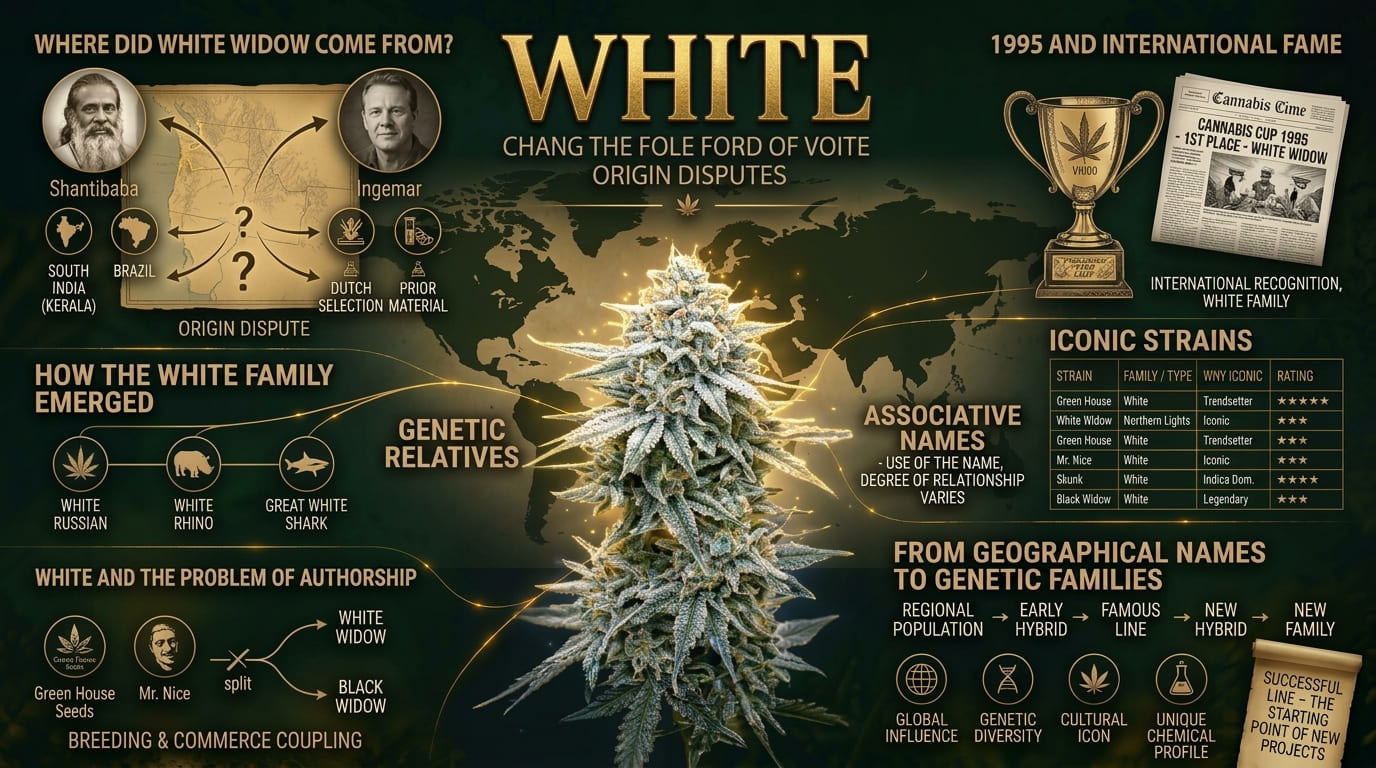
After Kush, Afghani, Haze, Skunk and Northern Lights the history moves on to another type of genetic families. White shows how a successful breeding line can give rise to an entire group of subsequent names. The central place here is occupied by White Widow, which appeared in the Netherlands in the early 1990s. In 1995 it took first place at the Cannabis Cup and quickly became one of the most famous lines of its time.
The origin of White Widow is one of the best-known controversies in the history of modern Cannabis genetics. The most widespread version is connected with the breeder Shantibaba, who claimed that the line was created on the basis of South Indian material from Kerala and a Brazilian line. However there is also the version of the Dutch breeder Ingemar, who stated that it was he who obtained the starting material and created the predecessor of White Widow even before its commercial appearance under that name. It is difficult to resolve the dispute definitively today. Unlike modern breeding programmes, in the 1980s–1990s the origin of many lines was recorded incompletely, and part of the genetic material was transferred between private collectors and breeders.
Therefore White Widow is a good example of why a well-known commercial name does not always make it possible to accurately restore the original pedigree.
Despite the disputed origin, the victory of White Widow at the Cannabis Cup in 1995 is well documented. After that the name gained international fame, and the word White gradually began to be used in new breeding names. Thus the concept of the White Family was formed.
Some lines are indeed linked to White Widow or claimed as its derivatives. Among the best-known historical names are White Russian, White Rhino and Great White Shark. But the mere presence of the word White in the name does not yet prove genetic relatedness. As White Widow became popular, different breeders began using this word for their own lines — sometimes because of supposed origin, sometimes because of a characteristic external trait or simply historical association. As a result a family of names arose within which the degree of real genetic relatedness could vary greatly.
The history of White Widow also shows how closely in the 1990s breeding, commerce and authorship were intertwined. Shantibaba linked the creation of White Widow with his work at Green House Seeds. After his departure and the founding of Mr. Nice a similar line became known as Black Widow.
Therefore today there exist different versions of the origin of White Widow and Black Widow. For the researcher this is another example of the fact that the name of a plant and its genetic origin are not always the same thing.
If at the beginning of our history names were largely connected with regions, by the era of White Widow the situation had changed.
The conditional chain looks like this:
regional population → early hybrid → well-known line → new hybrid → new family
A successful line became the starting point for new projects, and its name began to live a life of its own. That is why White Widow is important not only as an individual historical strain. It shows the transition to an era when the reputation of a particular line itself became part of genetic history.
Iconic strains:
| Strain | Family / direction | Why iconic |
| Haze | Historical foundation of the Haze family | |
| Northern Lights | One of the best-known lines of early Dutch breeding | |
| Skunk | Classic example of an early complex hybrid | |
| Afghani | Iconic line of the Afghan direction | |
| White | One of the best-known lines of the 1990s | |
| White | Well-known representative of the White direction | |
| White | Iconic line of the White Family | |
| White | Another historically well-known representative of White |
The history of the families already examined shows how strongly the very principle of forming genetics has changed.
At this stage the old genetics already cease to exist as isolated directions. They begin to intersect with one another, and the origin of new strains increasingly resembles a complex network rather than a simple chain.
It is precisely this process that is especially noticeable from the late 1990s and in the 2000s.
In the second part we will move on to a new era — Diesel, OG, Cookies, Gelato, Wedding Cake, Zkittlez and Runtz, where genetic families become even more complex and the influence of individual American lines begins to spread far beyond their original environment.
 Read the continuation of the article: "How the most famous cannabis genetics families appeared Part 2".
 Написать отзыв